
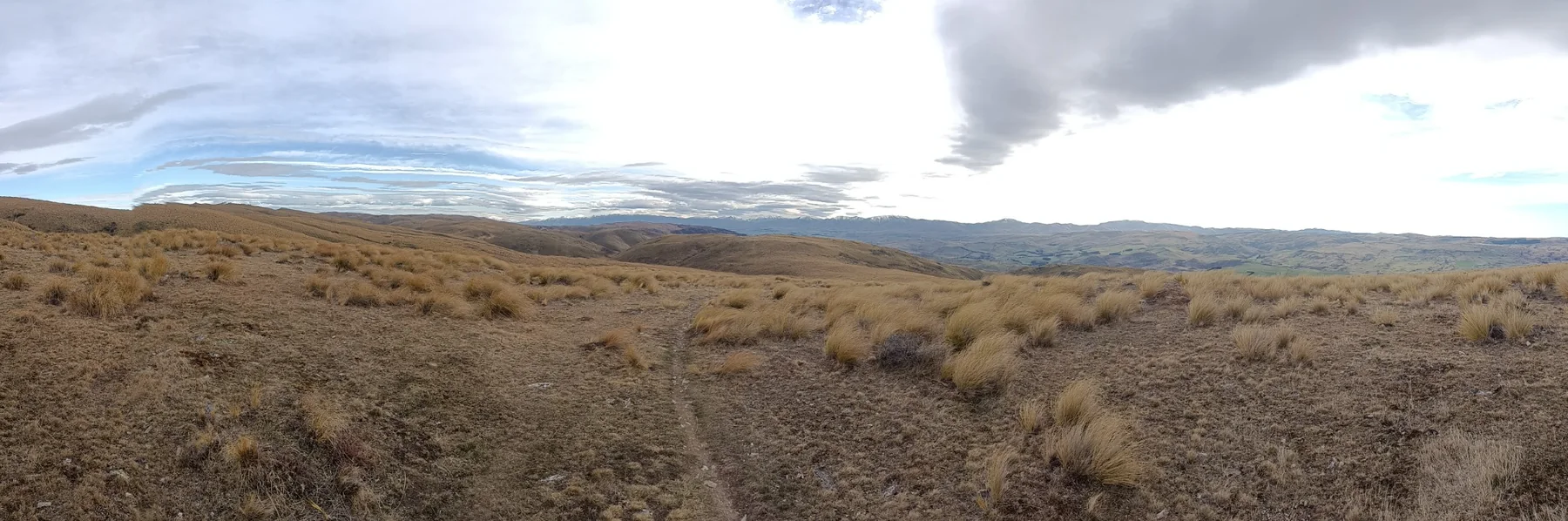
Otago Schist · Gold exploration
Where else might Otago host major gold systems?
Andrew Allibone’s 2025 AusIMM New Zealand Branch presentation examines the discovery of Rise and Shine, the regional shear zones and the geological questions that remain open in the Otago Schist.
Regional geological interpretation
Wairiri Exploration Group interpretation and commentary, reviewed 11 October 2026. Source presentation: Andrew Allibone, AusIMM New Zealand Branch, 2025. Geological hypotheses in the slides are not established resources.
What changed at Rise and Shine?
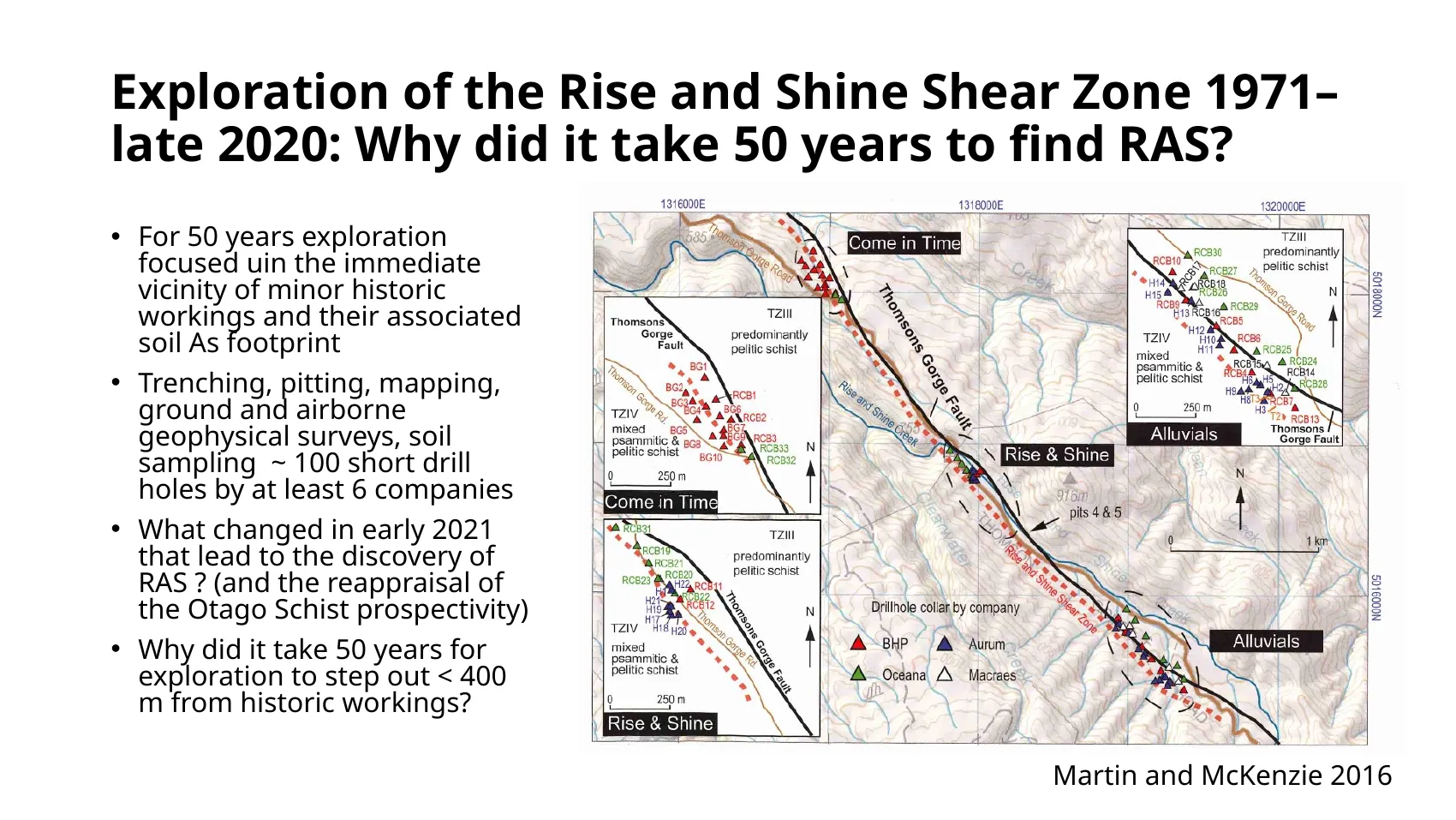
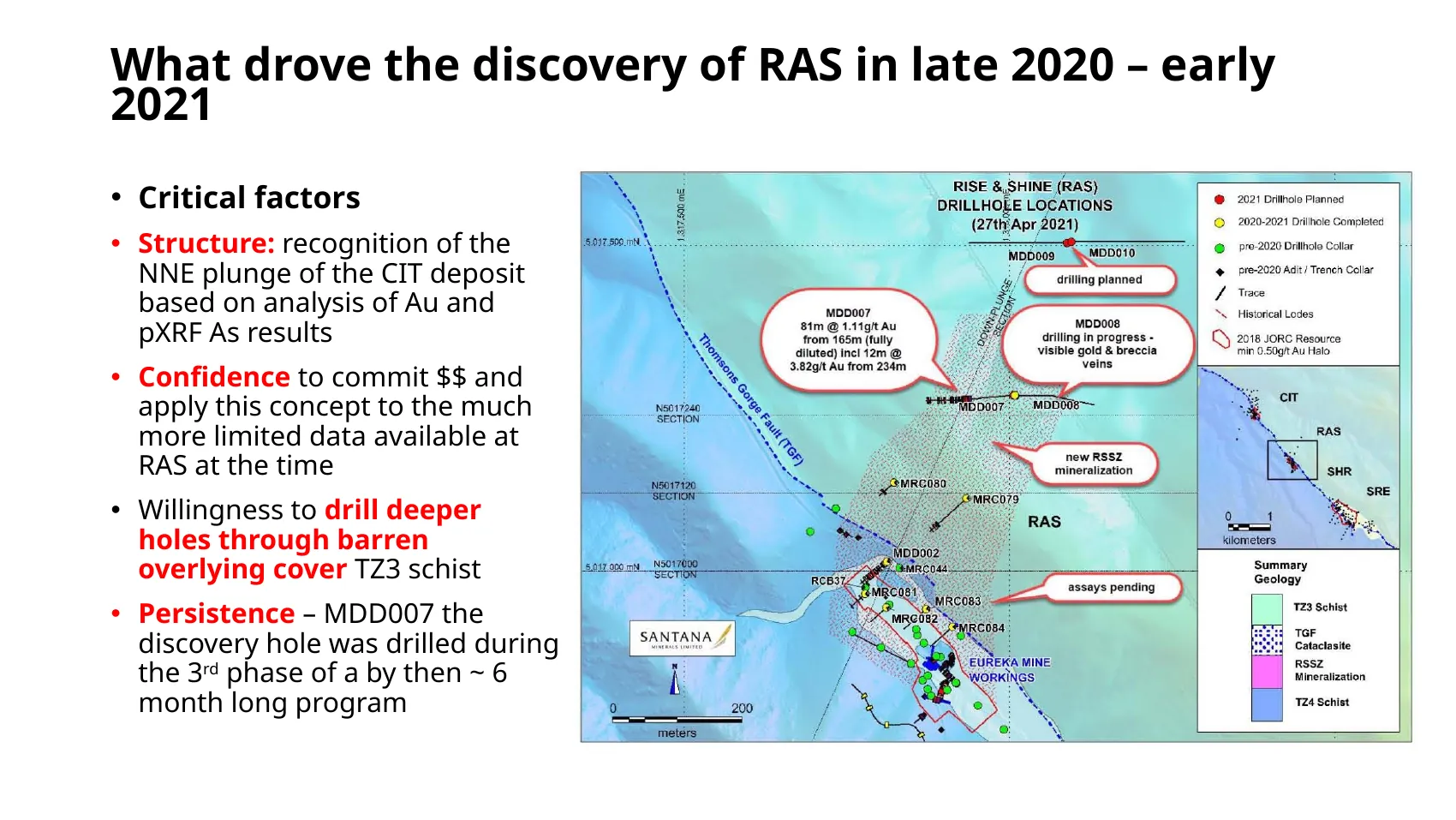
The discovery of Rise and Shine in 2021 altered perceptions of Otago Schist-hosted gold. Earlier exploration had repeatedly returned to shallow targets near historic workings and soil arsenic anomalies. The presentation records roughly 100 short drill holes completed by at least six companies between 1971 and 2020, most clustered around already recognised mineralisation.
The change was geological as well as financial. Interpretation of a north-northeast plunge at Come-in-Time, using gold assays and portable XRF arsenic results, supported drilling beyond the established surface footprint. Deeper holes passed through relatively unmineralised overlying schist, and MDD007 intersected Rise and Shine mineralisation during a later phase of the 2020–21 programme.
This history illustrates a real exploration risk: drilling can be concentrated around existing workings without testing the structural position in which larger mineralised shoots might continue under cover.
Exploration history and discovery
Fifty years of drilling, followed by a change in targeting
Regional targeting
Major shear zones are central to the opportunity
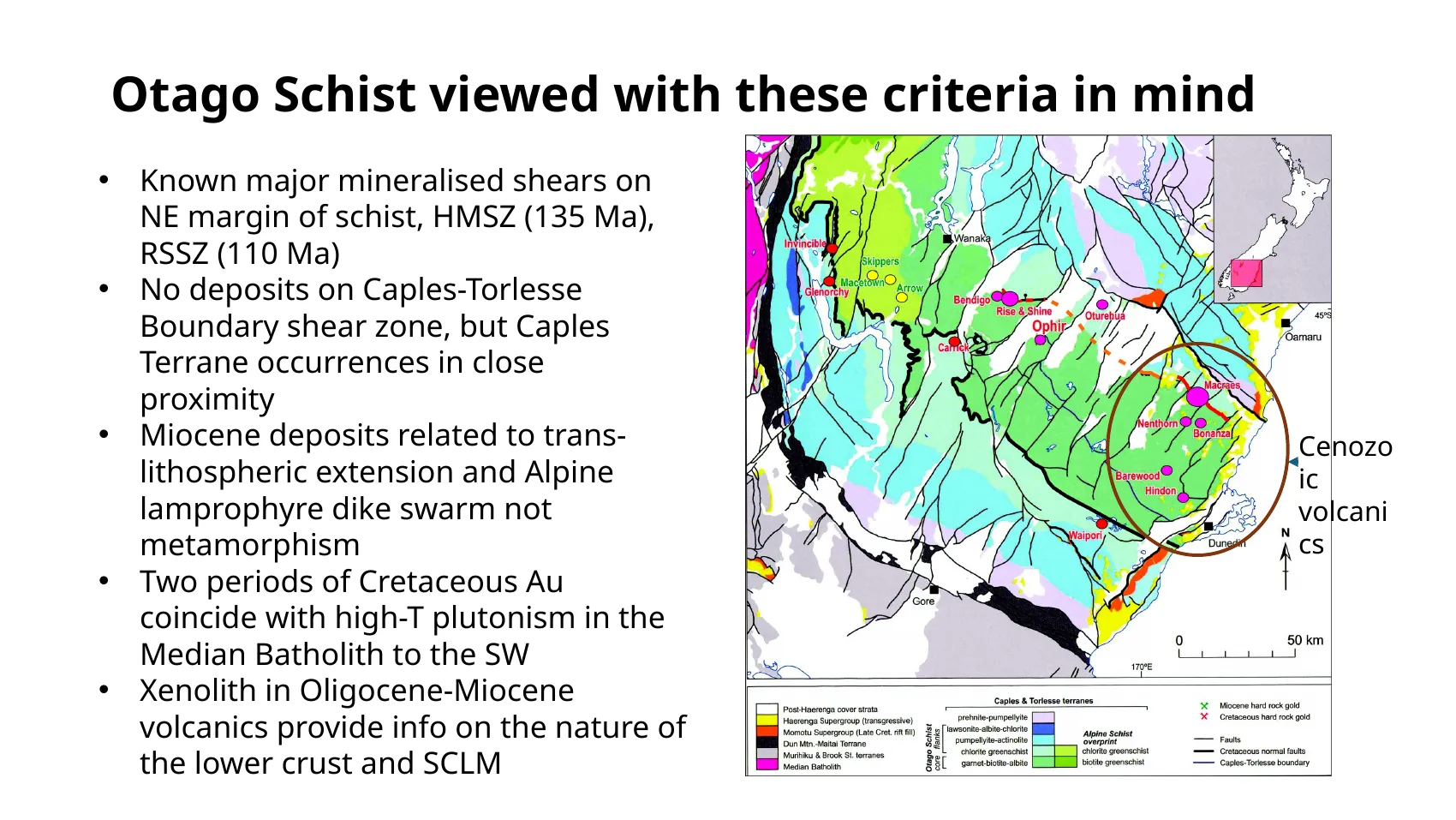
The Hyde–Macraes and Rise and Shine shear zones show that mineralised structures can extend for many kilometres, but their orientation and present-day surface expression do not by themselves establish continuity of economic gold grades. Allibone draws attention to major structures near the textural zone 3–4 transition, multiple periods of Cretaceous hydrothermal activity and the need to understand how those systems connect at depth.
The presentation also compares established metamorphic-fluid models with alternative hypotheses involving deeper crustal or mantle contributions. These models are not resolved by the examples presented. They lead to different exploration tests, including structural mapping, geophysics, host-rock and alteration geochemistry, geochronology, and targeted drilling beneath cover.
Does the Macraes camp predict undiscovered million-ounce deposits?
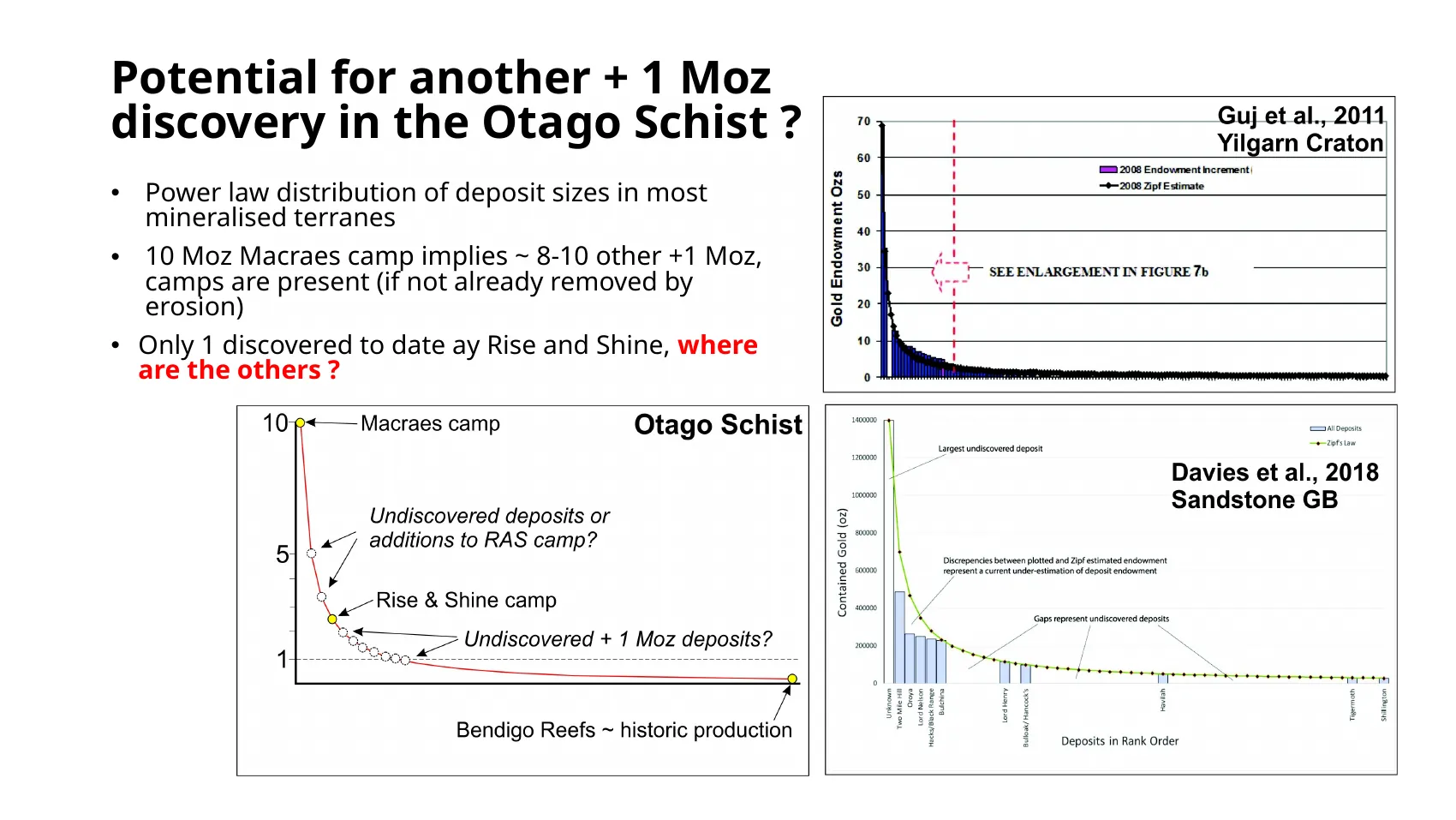
Slide 6 applies a size–frequency relationship drawn from other mineral provinces to the Otago Schist. On that basis, Allibone suggests that a Macraes camp of approximately 10 Moz might be accompanied by about eight to ten other camps above 1 Moz, with Rise and Shine the single identified example in the presentation. This is an illustrative extrapolation, not a Mineral Resource estimate or a calibrated probability of discovery. It depends on assumptions about erosion, preservation, exploration maturity and whether the analogue provinces are comparable.
There is a geological basis for continued testing of unrecognised structures, but the number and size of undiscovered deposits cannot be established from Macraes and Rise and Shine alone.
Implications for exploration programmes
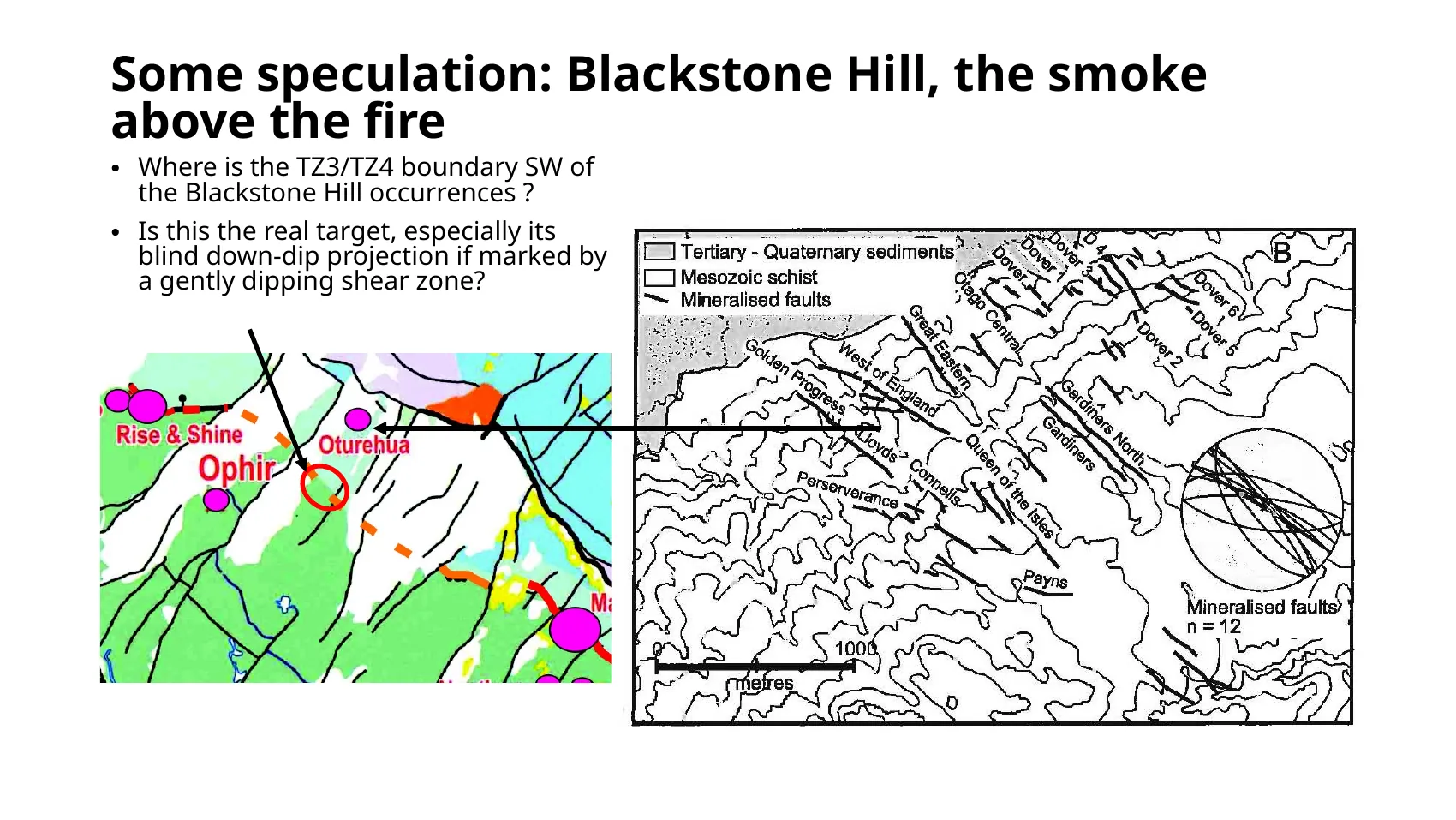
The useful next step is not a regional ounce forecast. It is to identify prospective structures that have not been adequately mapped or drill tested; reconstruct their relationships to metamorphic zonation and cover; and rank targets against observable geological evidence. The presentation gives particular attention to the Blackstone Hill area as an example of a possible blind structural target, rather than a confirmed deposit.
Wairiri undertakes historical-data compilation, structural interpretation, geological mapping, GIS integration, survey control, drilling programme management and geological modelling for gold and critical-mineral projects in Otago. These services can be applied to testing targets of the type discussed in the presentation.
Source and attribution: Andrew Allibone (2025), Tracing and ranking major prospective structures in the Otago Schist, presentation to the AusIMM New Zealand Branch. Reproduced with approval for public distribution. Maps and diagrams carry the source acknowledgements shown in the original presentation. Historic figures and exploration scenarios should not be treated as current company resource statements.
For the wider regional setting, see Wairiri’s Otago gold exploration services and Why explore in New Zealand?.
Otago gold exploration
Have a structural gold target to test?
Talk to Wairiri about historic drilling, geological mapping, target generation or a staged field and drilling programme.